Bastar Dhokra: Sourcing Tribal Metal Craft for Export
A guide to sourcing Bastar Dhokra lost-wax brass for export — the artisan clusters, GI context, handling variability, MOQ, and museum/gallery demand
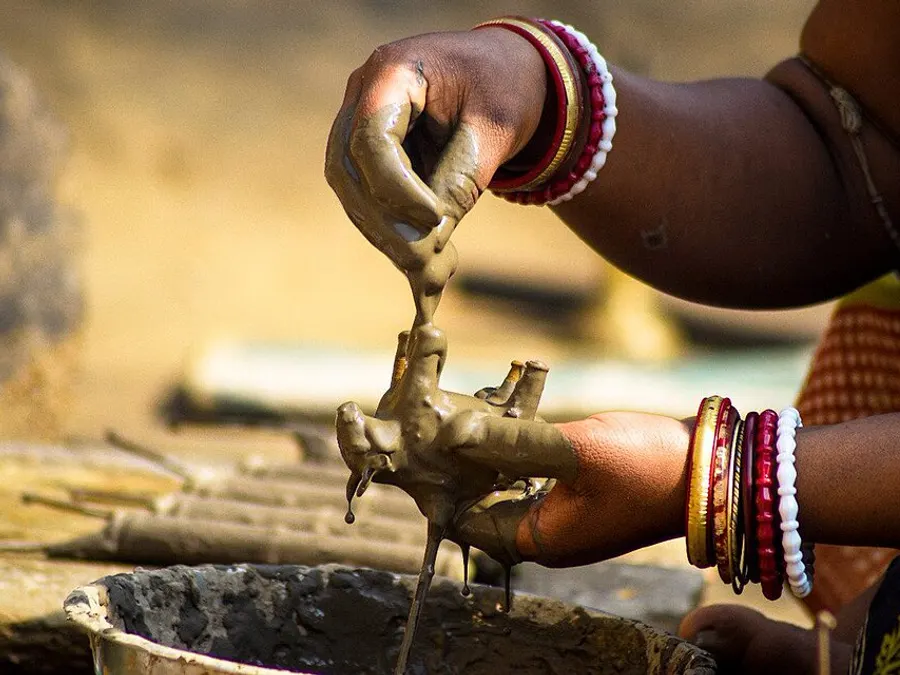
Bastar Dhokra is a non-ferrous metal (predominantly brass) lost-wax cast craft from the Bastar region of Chhattisgarh, made largely by the Ghadwa artisan community, with Kondagaon as the main production cluster. It is a registered Geographical Indication in India, which strengthens its export positioning for buyers who want provenance-backed craft. Sourcing well means understanding the cluster geography, the inherent piece-to-piece variability of the lost-wax process, realistic MOQs, and the documentation pipeline (IEC, GST, customs, EPCH membership, RoDTEP) that Indian exporters must clear before a shipment leaves.
What Bastar Dhokra is, and why it travels well
Dhokra is a non-ferrous metal casting tradition that uses the lost-wax (cire perdue) technique: the artisan shapes a clay-core model, coats it in wax, then layers fine clay over the wax, melts the wax out, and pours molten brass into the mould. The mould is broken to release the casting, which is why every piece is one-of-a-kind and bears a slightly rough, organic surface. Bastar Dhokra specifically is a registered Geographical Indication, which matters for export positioning — buyers (especially in Europe, Japan, and the US) increasingly ask for craft with provable origin stories, and a GI gives you a defensible answer.
For overseas buyers, the appeal is the visible hand of the maker and the tribal iconography — horses, elephants, deities, lamps, jewellery, and figures drawn from Gond and Bastar mythology. The piece itself is the sell; the artisan signature is the brand.
The artisan clusters, and how to approach them
The main hub is Kondagaon in Bastar district, Chhattisgarh. Other production pockets sit across the Bastar division — Dantewada, Bijapur, Narayanpur, and the Kanker belt — and a small but commercial cluster around Raipur. A few cooperatives and NGOs, including the well-known Bastar Shilpkendra network, work with artisan families. There is also a sizeable secondary cluster in West Bengal (Bankura and Bardhaman Dhokra) which is a related but distinct tradition; if a buyer wants Bastar specifically, the source and documentation should reflect that.
Practical ways for an Indian exporter to open a sourcing pipeline:
- Visit during the production season (the cooler months are friendlier for travel and casting) and spend at least three to four days in-cluster.
- Work through the Office of the Development Commissioner (Handicrafts) and EPCH (Export Promotion Council for Handicrafts) for vetted artisan lists and the “Made in India” handicraft network.
- Engage directly with cooperatives in Kondagaon and Bade Dongarpara, or with local NGOs that aggregate artisan output.
- Build relationships with 8–12 artisan families so a single cancelled order never wipes out your supply.
- Use GreenFlip India’s cluster desk to be introduced to vetted Bastar producers, and to access the wider GreenFlip network (greenflip.org) for cross-border demand signals.
GI context: what to use, what to verify
Bastar Dhokra is a registered GI, and the GI Registry of India maintains the official record (including applicant, goods class, and the GI logo usage rules). The GI tag is a commercial asset — it allows you to use the GI name and logo on packaging, catalogues, and invoices, which overseas buyers and museum procurement officers recognise. It also gives you a route to push back on look-alike products from other states.
Verify on the GI Registry India portal: the current registered proprietor/applicant, the exact authorised user status, the goods description covered, and the conditions for logo use. If you are not the registered applicant or an authorised user, you cannot legally use the GI name on your own labels — sort that out before the first shipment.
Handling variability: how to brief clients
Because every mould is destroyed in casting, Dhokra is a high-variability product. Surface finish, weight, and small proportions will differ even between “identical” pieces. A few honest moves that make export smooth:
- Grade pieces into A and B (sometimes C) tiers and price accordingly. Tell the buyer in writing that A-grade is chosen for finish and structural soundness, B-grade has visible surface variation but is structurally sound.
- Photobatch: photograph every piece with a number tag, send a selection sheet, and only cast off what is approved. For larger custom orders, share wax prototypes before metal is poured.
- Inspect for casting blow-holes and structural cracks; minor surface pits are in-character and accepted, but cracks around thin features (legs, handles) are rejection-grade.
- Pack individually in corrugated and thermocol, then in wooden crates for LCL sea freight; Dhokra is heavy for its size, so under-pack and the finish suffers.
MOQ, lead time, and pricing reality
MOQs are flexible because the unit of production is one piece, not a batch. Realistic ranges:
- Stock designs: typically 20–50 pieces per SKU per shipment, depending on piece size and price point.
- Custom designs: 30–100 pieces, because each piece is a fresh wax and mould — true customisation at low volume is what this craft does best.
- Lead time: 6–10 weeks for stock items already in the cluster; 12–20 weeks for a new design from sketch to finished cast and patina.
Pricing should reflect artisan wages, brass content (which moves with the LME brass/copper alloy benchmark), and the export-grade finishing you apply. Build a 25–35% margin for B2B wholesale and a higher margin for direct-to-consumer or museum sales.
Where the demand is: museums, galleries, and design
Museum and gallery buyers — V&A, Musée du quai Branly, the Met, and a long tail of design galleries in Europe, the US, and Japan — buy Bastar Dhokra because the GI tag, the lost-wax process, and the tribal provenance are exactly what their curatorial briefs ask for. Lead times are long (6–12 months from enquiry to delivery), but per-piece values are higher and repeat orders are common. Design houses and homeware buyers in Scandinavia, Italy, and Japan buy smaller volumes at premium price points. Hospitality (boutique hotels, restaurants) takes functional pieces — lamps, bowls, door handles — often customised.
Trade mechanics: documents, customs, and incentives
An Indian exporter of handicrafts typically needs: an IEC (Import Export Code) from DGFT, GST registration, an EPCH membership or RCMC for handicraft exports, an AD code registration with the bank, and the standard shipping documents (commercial invoice, packing list, bill of lading/airway bill, certificate of origin, and a shipping bill filed via ICEGATE). For handcrafted goods, a “Handicraft” declaration on the shipping bill supports the relevant export incentive claim.
- DGFT: issue and manage your IEC; check the current Handbook of Procedures for any updated handicraft-specific benefits.
- ICEGATE / CBIC: file the shipping bill, claim IGST refund on exports, and use the correct ITC-HS code for the finished article.
- EPCH: get your RCMC for handicrafts — it is the body that supports Indian handicraft exporters at trade fairs and policy level.
- RoDTEP: the Remission of Duties and Taxes on Exported Products scheme is claimable on eligible handicraft shipments; verify current scrip rates and product eligibility on the DGFT/ICEGATE portal.
- BIS: standards may apply to specific metal composition or to items used in food-contact or children’s products — verify on the BIS portal before you commit to a claim like “lead-free” or “food-safe.”
- GI: as above, confirm authorised-user status before you print the Bastar Dhokra name on your packaging.
Verify current requirements, rates, and form numbers with DGFT, CBIC/customs (ICEGATE), the GI Registry, and BIS before each shipment — these move and you do not want to ship on a stale rule.
Pre-shipment checklist
- IEC active; GST returns current; EPCH RCMC in place.
- Artisan invoices collected for traceability; batch-wise photolog archived.
- A/B grading recorded per piece; selection sheet approved by buyer.
- Casting quality: no structural cracks; surface pits documented as in-character.
- GI label/logo rights confirmed with the authorised user; care card and provenance note included.
- ITC-HS code and shipping bill filed via ICEGATE; RoDTEP claim preserved; certificate of origin ready.
- Packing: individual wrap, corrugated wrap, wooden crate, desiccant for sea freight.
Bottom line
Bastar Dhokra is one of the cleanest export stories in Indian craft — a registered GI, a distinctive lost-wax technique, an identifiable artisan community, and steady demand from museums, galleries, and design-led buyers. The exporter who wins is the one who respects the cluster, grades honestly, fixes the GI paperwork upfront, and treats the trade-mechanics layer (IEC, EPCH, ICEGATE, RoDTEP, BIS) as seriously as the design brief. Get those right and the craft sells itself, both in India and through the wider GreenFlip network.
FAQ
Does Bastar Dhokra have a Geographical Indication (GI) tag, and how can an exporter verify authenticity when sourcing from clusters?+
Yes, Bastar Dhokra is a GI-registered craft. Buyers should source primarily from artisan clusters in Kondagaon and surrounding blocks of Bastar district, Chhattisgarh, and request GI-based documentation or cluster-level certification (e.g., from the recognised SHGs or the Chhattisgarh Hastshilp Vikas Board) to confirm geographic origin. Cross-checking with the GI Registry's public database is recommended before finalising large orders.
What is the typical minimum order quantity (MOQ) and how should an exporter approach artisan clusters for consistent supply?+
MOQs are not standardised and depend on the cluster, design, and piece size, since each item is hand-cast using the lost-wax method. Exporters usually aggregate orders by working directly with empanelled SHGs, the Kondagaon-based artisan cooperatives, or through state emporia and TRIFED-adjacent channels, and by placing rolling forecasts so clusters can plan casting cycles. Building a single cluster relationship is more practical than juggling many small units.
How do exporters handle the natural size, weight, and finish variability of Dhokra pieces when supplying galleries and museums abroad?+
Variability is inherent to the lost-wax process and is often treated as a feature, not a defect, by museum and gallery buyers. Exporters typically grade pieces, send pre-shipment samples, declare tolerances in proforma invoices, and position the craft as 'one-of-a-kind' rather than uniform stock. Robust, foam-lined, individual packing is essential because the pieces are hollow cast brass and can crack under impact.
Ready to source?
Submit one RFQ and we route it to matched suppliers across 12 origins.
Request a bulk quote →